Head loss in a pipe, with the Darcy-Weisbach equation
Flow velocity, Reynolds number, the friction factor from an explicit approximation, the friction head loss, the pressure drop and the hydraulic power needed, for water in a 150 mm pipe.
Try the beta version Plans and prices
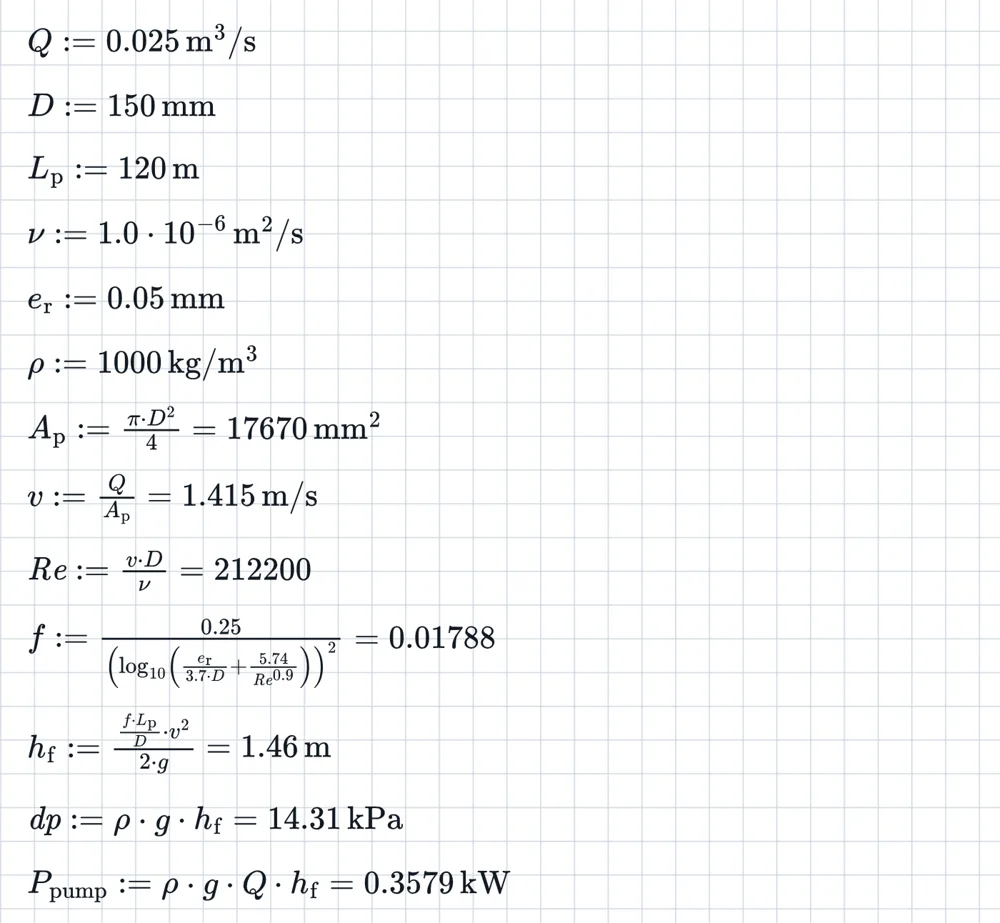
The calculation
Q := 0.025 m^3/s
D := 150 mm
L_p := 120 m
nu := 1.0e-6 m^2/s
e_r := 0.05 mm
rho := 1000 kg/m^3
A_p := pi*D^2/4 = mm^2
v := Q/A_p = m/s
Re := v*D/nu =
f := 0.25/(log10(e_r/(3.7*D) + 5.74/Re^0.9))^2 =
h_f := f*L_p/D*v^2/(2*g) = m
dp := rho*g*h_f = kPa
P_pump := rho*g*Q*h_f = kW
Results for these inputs
- Velocity 1.41 m/s, Reynolds number 212 000 (turbulent).
- Friction factor 0.0179.
- Head loss 1.46 m over 120 m, pressure drop 14.3 kPa.
- Hydraulic power 0.36 kW.
How it works
hf = f·(L/D)·v²/(2g), with the friction factor from the explicit Swamee–Jain form of the Colebrook relation. g is built in as 9.80665 m/s². Pressure drop is ρ·g·hf and hydraulic power ρ·g·Q·hf.
These calculations use classical textbook mechanics, not a design code. For design, use the method, factors and checks that apply to your work and have the result checked by a competent person.
Size a pipe
Find the diameter for a given head loss with root or solve, or tabulate several diameters in a spreadsheet with units and plot the head loss.
Questions
How is head loss in a pipe calculated?
With the Darcy-Weisbach equation, h_f = f·(L/D)·v²/(2g), where f is the friction factor from the Reynolds number and the relative roughness.
Which friction factor formula is used?
The explicit Swamee–Jain approximation, f = 0.25/[log10(ε/3.7D + 5.74/Re^0.9)]², valid for turbulent flow.
Also used for
- Structural calculations
- Worked examples
- Calculation sheets
- Report generator
- Online calculation pad
- Unit calculator
- Matrix calculator
- Equation solver
- Graph plotter
- Spreadsheet with units
- For students
- Beam deflection
- Section properties
- Euler buckling
- Truss analysis
- Stiffness matrix method
- Natural frequency
- Principal stresses
- Heat transfer, U-value
- Cable sag and tension
- Civil and mechanical
- Private and local
- .eqnpad files
Equation Pad runs in your browser, with nothing to install, and we never see or store your calculations. Results must be checked by a competent person before they are relied on; see the disclaimer.