U-value and heat loss of a layered wall
The total thermal resistance of a wall made of brick, insulation and plasterboard with the inside and outside surface resistances, its U-value, the heat flow through 25 m² at a 20 K temperature difference, and the inside surface temperature.
Try the beta version Plans and prices
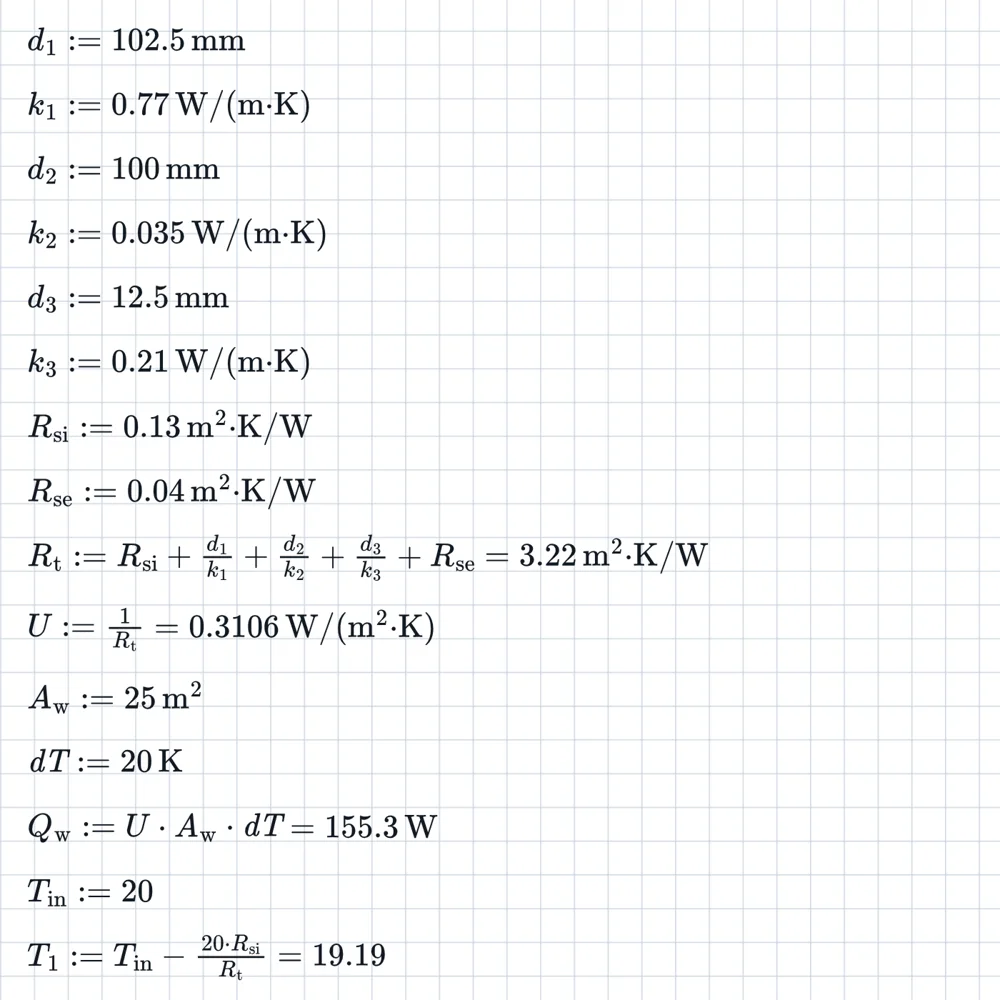
The calculation
d_1 := 102.5 mm
k_1 := 0.77 W/(m*K)
d_2 := 100 mm
k_2 := 0.035 W/(m*K)
d_3 := 12.5 mm
k_3 := 0.21 W/(m*K)
R_si := 0.13 m^2*K/W
R_se := 0.04 m^2*K/W
R_t := R_si + d_1/k_1 + d_2/k_2 + d_3/k_3 + R_se = m^2*K/W
U := 1/R_t = W/(m^2*K)
A_w := 25 m^2
dT := 20 K
Q_w := U*A_w*dT = W
T_in := 20
T_1 := T_in - 20*R_si/R_t =
Results for these inputs
- Total resistance 3.22 m²·K/W.
- U-value 0.31 W/(m²·K).
- Heat loss 155 W through 25 m² at ΔT = 20 K.
- Inside surface temperature about 19.2 °C.
How it works
Each layer adds a resistance d/k; the surface resistances are added on each side, U = 1/Rt and Q = U·A·ΔT. Thermal bridges, fixings and air gaps are not included here.
These calculations use classical textbook mechanics, not a design code. For design, use the method, factors and checks that apply to your work and have the result checked by a competent person.
Compare build-ups
Make the insulation thickness a variable and plot U against it, or list several build-ups in a spreadsheet and pick the one that meets your target.
Questions
How do I calculate a U-value?
Add the thermal resistances of all layers (thickness divided by conductivity) and the surface resistances, then take U = 1/R_total.
Are the units handled?
Yes: mm, W/(m·K) and m²·K/W combine correctly and the U-value comes out in W/(m²·K).
Also used for
- Structural calculations
- Worked examples
- Calculation sheets
- Report generator
- Online calculation pad
- Unit calculator
- Matrix calculator
- Equation solver
- Graph plotter
- Spreadsheet with units
- For students
- Beam deflection
- Section properties
- Euler buckling
- Truss analysis
- Stiffness matrix method
- Natural frequency
- Principal stresses
- Pipe flow head loss
- Cable sag and tension
- Civil and mechanical
- Private and local
- .eqnpad files
Equation Pad runs in your browser, with nothing to install, and we never see or store your calculations. Results must be checked by a competent person before they are relied on; see the disclaimer.