Euler buckling load of a column
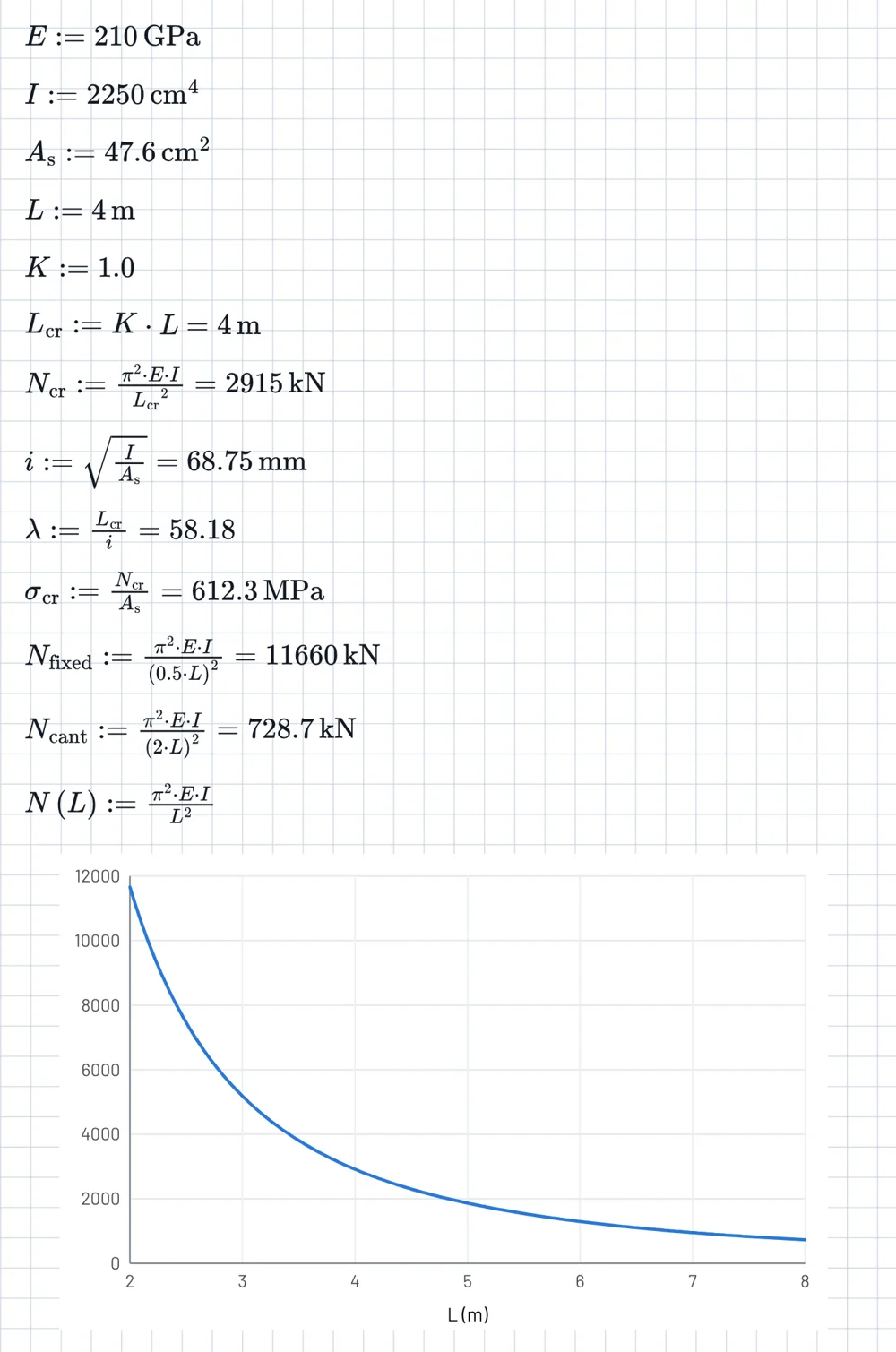
The elastic critical load of a strut, its slenderness and the critical stress, for pinned ends, fixed ends and a cantilever, with a graph of how the buckling load falls as the column gets longer.
Try the beta version Plans and prices
The calculation
E := 210 GPa
I := 2250 cm^4
A_s := 47.6 cm^2
L := 4 m
K := 1.0
L_cr := K*L = m
N_cr := pi^2*E*I/L_cr^2 = kN
i := sqrt(I/A_s) = mm
lambda := L_cr/i =
sigma_cr := N_cr/A_s = MPa
N_fixed := pi^2*E*I/(0.5*L)^2 = kN
N_cant := pi^2*E*I/(2*L)^2 = kN
N(L) := pi^2*E*I/L^2
plot(N(L)/(1 kN), L, 2 m, 8 m)
Results for these inputs
- Pinned ends, 4 m: Ncr = 2915 kN, slenderness 58.2, critical stress 612 MPa.
- Fixed ends (effective length 0.5L): 11 660 kN.
- Cantilever (effective length 2L): 729 kN.
How it works
Euler’s formula Ncr = π²EI/Lcr², with the effective length Lcr = K·L for the end conditions. Slenderness is Lcr/i with the radius of gyration i = √(I/A). The Euler load is an upper bound for a perfectly straight elastic strut; real columns fail at lower loads because of imperfections and yielding.
These calculations use classical textbook mechanics, not a design code. For design, use the method, factors and checks that apply to your work and have the result checked by a competent person.
Plot it
plot(N(L)/(1 kN), L, 2 m, 8 m) draws the buckling load against length on the sheet. See the graph plotter.
Questions
What effective length factor should I use?
For the classical cases: pinned at both ends K = 1, fixed at both ends K = 0.5, fixed and pinned K ≈ 0.7, cantilever K = 2.
Why is the Euler load higher than the real strength?
It assumes a perfectly straight, perfectly elastic strut. Imperfections, residual stresses and yielding reduce the real capacity, especially for stocky columns.
Also used for
- Structural calculations
- Worked examples
- Calculation sheets
- Report generator
- Online calculation pad
- Unit calculator
- Matrix calculator
- Equation solver
- Graph plotter
- Spreadsheet with units
- For students
- Beam deflection
- Section properties
- Truss analysis
- Stiffness matrix method
- Natural frequency
- Principal stresses
- Pipe flow head loss
- Heat transfer, U-value
- Cable sag and tension
- Civil and mechanical
- Private and local
- .eqnpad files
Equation Pad runs in your browser, with nothing to install, and we never see or store your calculations. Results must be checked by a competent person before they are relied on; see the disclaimer.