Sag and tension of a cable
A cable carrying a uniform load along its span hangs as a parabola. From the span and the sag: the horizontal tension, the vertical reactions, the maximum tension at the supports, the length of the cable and the angle at the ends, with its shape plotted.
Try the beta version Plans and prices
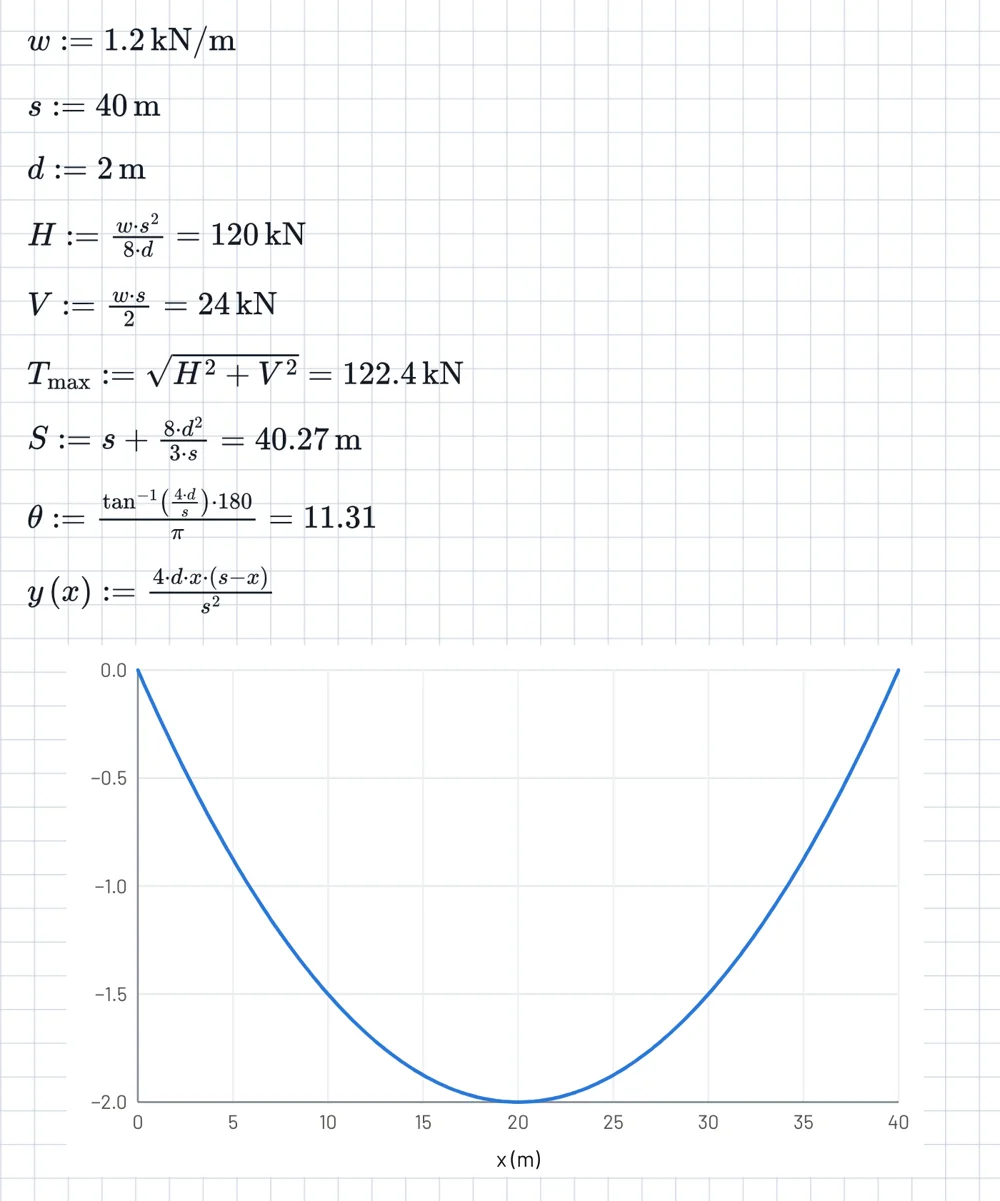
The calculation
w := 1.2 kN/m
s := 40 m
d := 2 m
H := w*s^2/(8*d) = kN
V := w*s/2 = kN
T_max := sqrt(H^2 + V^2) = kN
S := s + 8*d^2/(3*s) = m
theta := atan(4*d/s)*180/pi =
y(x) := 4*d*x*(s - x)/s^2
plot(-y(x)/(1 m), x, 0 m, s)
Results for these inputs
- Horizontal tension 120 kN, vertical reaction 24 kN at each support.
- Maximum tension 122.4 kN.
- Cable length 40.27 m for a 40 m span.
- Angle at the supports 11.3°.
How it works
For a uniform load w over the span s with sag d, the horizontal tension is H = ws²/(8d); the vertical reaction is ws/2; the length of a shallow parabola is s + 8d²/(3s). Halving the sag doubles the tension.
These calculations use classical textbook mechanics, not a design code. For design, use the method, factors and checks that apply to your work and have the result checked by a competent person.
Change the sag
Make the sag a variable and plot the tension against it to find a sensible proportion, or solve for the sag that gives a chosen tension with solve.
Questions
How is cable tension calculated from sag?
For a uniformly loaded cable, the horizontal tension is H = w·s²/(8·d); the maximum tension at the supports is √(H² + (w·s/2)²).
How long is a sagging cable?
For a shallow parabola, L ≈ s + 8d²/(3s), where s is the span and d the sag.
Also used for
- Structural calculations
- Worked examples
- Calculation sheets
- Report generator
- Online calculation pad
- Unit calculator
- Matrix calculator
- Equation solver
- Graph plotter
- Spreadsheet with units
- For students
- Beam deflection
- Section properties
- Euler buckling
- Truss analysis
- Stiffness matrix method
- Natural frequency
- Principal stresses
- Pipe flow head loss
- Heat transfer, U-value
- Civil and mechanical
- Private and local
- .eqnpad files
Equation Pad runs in your browser, with nothing to install, and we never see or store your calculations. Results must be checked by a competent person before they are relied on; see the disclaimer.